
Tags: Narrative Journalism · Economic Inequality · Public Health · Solo Reporting
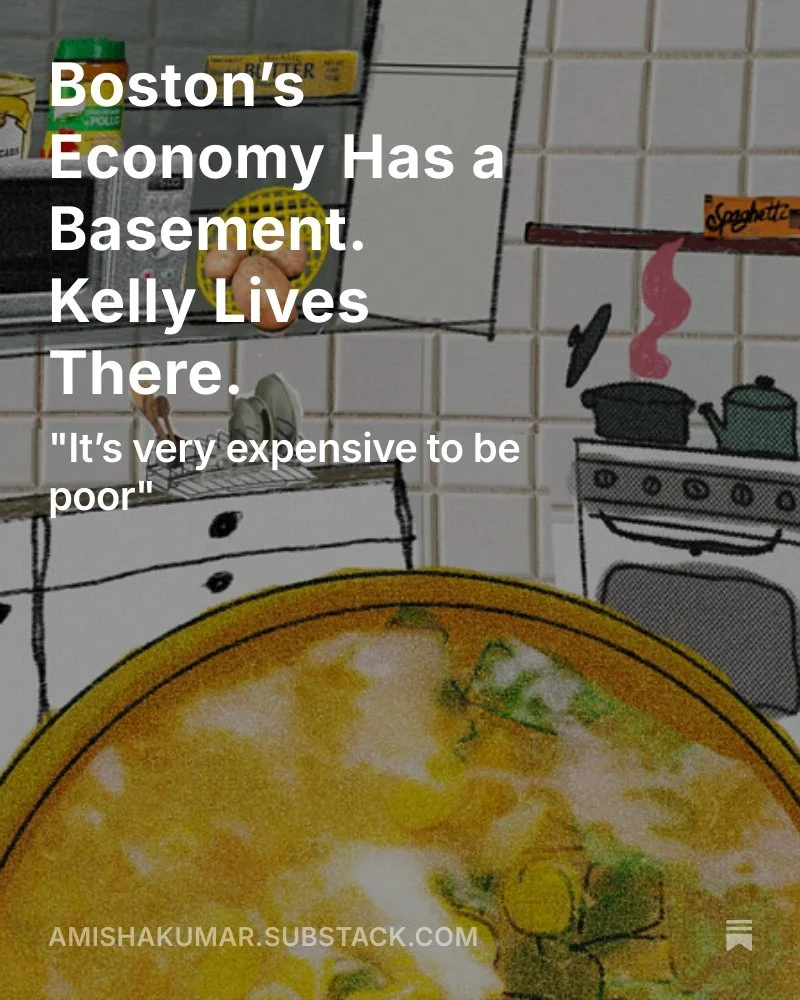
Boston’s Economy Has a Basement. Kelly Lives There.
It's very expensive to be poor.
Kelly Richards is a 45-year-old single mother living with a chronic illness in Beacon Hill — Boston's wealthiest neighborhood. I followed her through the daily math of survival: what public assistance covers, what it doesn't, and the constant tradeoffs that fill the gap and take care of her family. Her story became the entry point into a larger argument — that the hardship from food insecurity isn't just economic. It's a public health crisis, showing up in stress, in health outcomes, in the toll of constant precarity.
Context
Format: Nonfiction narrative feature, published on Substack
Reporting approach: Built around one person's sustained experience rather than a data-first frame. Reported for my senior year nonfiction narrative class at BU.
This piece pushed me to write economic hardship as a health story rather than a budget story — letting Kelly's daily tradeoffs carry the argument about what poverty actually costs a body, instead of leading with statistics and using her as an anecdote to illustrate them.
Top of the story:
On the 10th day of every month, $476 in SNAP benefits appear on Kelly Richards’ EBT card.
After a week of end-of-the-budget struggle meals, money is replenished, but she knows that it’s not going to be enough. By the end of what she calls “pay day,” Kelly has begun to compile a mental inventory of what she is going to sacrifice this month to stretch her fixed dollars and feed her two daughters, 14 and 21. (Kelly’s last name has been changed upon request to protect her identity.)
In Boston, women are more likely to be in poverty than men, family households are more likely than people without children, and single female-headed families are far more likely. The poverty rate for disabled individuals is even higher. Food insecurity is strongly tied to poverty.
Kelly is a 45-year-old woman with a frizzy, jet-black, wavy bob that she often wears in a precisely carved side part. She is a mother of two, a Boston Latin alum and a full-time liberal arts student at Bunker Hill Community College. She is the sole provider of her household. Kelly has been disabled for the past 22 years, suffering from a nerve condition, fibromyalgia, which creates chronic pain so excruciating she says a “regular person would wanna medicate their brains out.”
Kelly has been receiving $1260 on the third of every month in Social Security Disability Income since 2006, before which she was on welfare. This is also her monthly net income, which yearly is $15,120.
According to Housing and Urban Development in Massachusetts, “Extremely Low Income” is defined as income below or at 30% of the Area Median Income (AMI). Kelly, who lives in a Section 8 subsidized apartment in Beacon Hill, makes 11.9% of the AMI, placing her at the lowest end of the “Extremely Low Income” classification. In Boston’s economy, Kelly’s life is what the very bottom looks like.
Full story with graphics: https://amishakumar.substack.com/p/bostons-economy-has-a-basement-kelly?r=1qt2nh&utm_campaign=post&utm_medium=web&triedRedirect=true